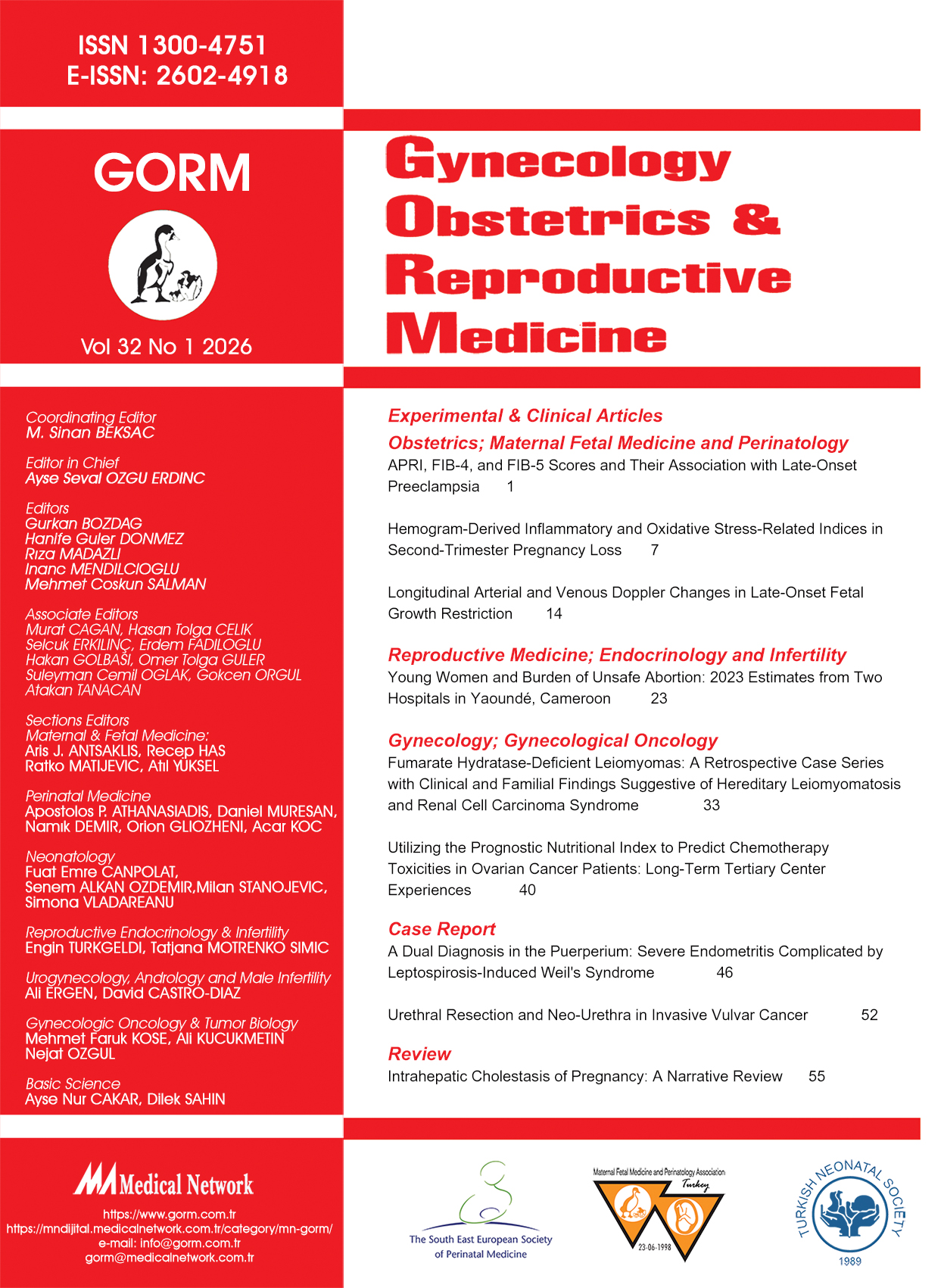
Fumarate Hydratase-Deficient Leiomyomas: A Retrospective Case Series with Clinical and Familial Findings Suggestive of Hereditary Leiomyomatosis and Renal Cell Carcinoma Syndrome
DOI:
https://doi.org/10.21613/GORM.2025.1668Keywords:
Fumarate hydratase deficiency, Hereditary leiomyomatosis and renal cell carcinoma Immunohistochemistry, Myomectomy, Uterine leiomyomaAbstract
OBJECTIVES: Fumarate hydratase (FH)-deficient uterine leiomyomas are a rare variant of smooth muscle tumors that may signal underlying hereditary syndromes like HLRCC, making their recognition crucial for gynecologists and pathologists.
STUDY DESIGN: This retrospective case series included ten patients who underwent surgery for uterine fibroids (benign smooth muscle tumors) between November 2015 and October 2023. Immunohistochemistry (IHC)-a lab technique using antibodies to detect specific proteins in tissue-was performed to confirm fumarate hydratase (FH) deficiency. After confirmation, patients underwent renal ultrasonography (kidney ultrasound) and had available imaging reviewed (CT and MRI, both advanced modalities). Each patient also underwent skin assessment for cutaneous leiomyomas (skin tumors) and received counseling for FH deficiency. Demographic, clinical, surgical, and familial data were collected and analyzed descriptively.
RESULTS: The mean age of patients was 40.2 years (range: 27-52), and the mean BMI was 26.9 ± 3.8 kg/m². Five patients underwent myomectomy, including one laparoscopically. The remaining five had a hysterectomy via Pfannenstiel incision. All diagnoses of FH-deficient leiomyomas were confirmed by immunohistochemistry. Two patients exhibited notable co-pathologies: one with adenomyosis and the other with a low-grade appendiceal mucinous neoplasm (LAMN). Family history findings included one patient with a sibling diagnosed with renal cell carcinoma, one patient with a sibling diagnosed with endometrial cancer, and another patient with first-degree relatives affected by uterine leiomyoma and endometrial intraepithelial neoplasia. Germline FH mutation analysis was not performed for any patient. Fertility-preserving procedures were offered to women of reproductive age, but no pregnancies were recorded during follow-up.
CONCLUSION: FH-deficient leiomyomas (fibroids lacking fumarate hydratase activity) should be considered in patients with large, multiple, or early-onset fibroids. Histopathology (examination of tissue under a microscope) and IHC (immunohistochemistry, a specialized lab technique for identifying proteins in tissue) are essential for diagnosis. Germline FH testing (testing for inherited mutations in the FH gene) was not systematically performed in our cohort. However, genetic referral (to a genetics specialist) was offered to 5 patients in the most recent year. This reflects a shift toward integrating molecular assessment into clinical practice. Our experience highlights the need to incorporate genetic counseling, routine renal imaging (regular kidney scans), and dermatologic evaluation (skin checks) into follow-up, especially for patients with features suggestive of a syndromic condition (that is, symptoms that could indicate a genetic syndrome).
Downloads
Downloads
Published
How to Cite
Issue
Section
License
Copyright (c) 2026 Tural Ismayilov, Suleyman Cemil Oglak, Nebahat Uzunay, Zeynep Yavas Yucel

This work is licensed under a Creative Commons Attribution 4.0 International License.

All the articles published in GORM are licensed with "Creative Commons Attribution 4.0 License (CC BY 4.0)". This license entitles all parties to copy, share and redistribute all the articles, data sets, figures and supplementary files published in this journal in data mining, search engines, web sites, blogs and other digital platforms under the condition of providing references.