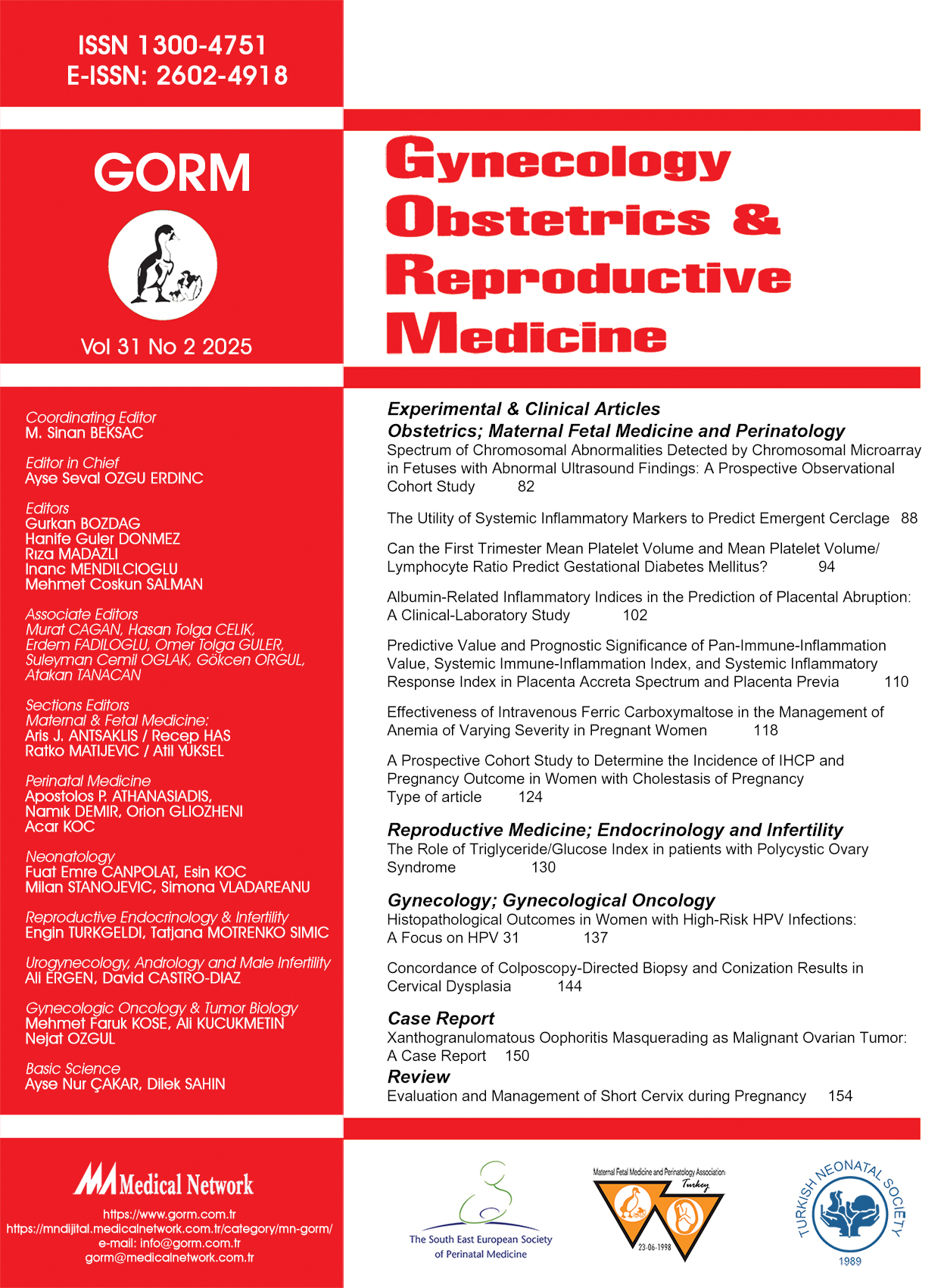
Effectiveness of Intravenous Ferric Carboxymaltose in the Management of Anemia of Varying Severity in Pregnant Women
DOI:
https://doi.org/10.21613/GORM.2025.1627Keywords:
anemia, ferric carboxymaltose, intravenous iron, iron deficiency, pregnancyAbstract
Objectives: To evaluate the effectiveness and safety of intravenous ferric carboxymaltose (FCM) in pregnant women with iron deficiency anemia (IDA), comparing outcomes between those with baseline hemoglobin (Hb) levels <8.5 g/dL and ≥8.5 g/dL. The study aimed to assess hematologic response, postpartum anemia rates, and obstetric and neonatal outcomes. Study Design: This retrospective observational study included 161 pregnant women with IDA who received FCM treatment (Hb 7–10 g/dL) between January 2020 and October 2024. Patients were divided into two groups based on initial Hb levels (Group 1: Hb<8.5 g/dL and Group 2: Hb ≥8.5 g/dL). Hematologic parameters were evaluated at baseline, 2 and 4 weeks post-treatment, and postpartum day 1. Obstetric and neonatal outcomes were also compared. Results: Both groups demonstrated significant increases in Hb levels post-treatment (p < 0.001). The increase was more pronounced at 2 and 4 weeks in the group with Hb <8.5 g/dL. At the fourth week after treatment, the increase in hemoglobin levels was 3.36 ± 1.14 g/dL in Group 1, compared to 2.40 ± 0.93 g/dL in Group 2 (all p < 0.001). Postpartum anemia was more common in Group 1 (36.8% vs. 20.3%, p = 0.044), although the absolute Hb gain was greater. There were no serious adverse events, and no statistically significant differences were found in adverse maternal or neonatal outcomes between the groups. Conclusion: Intravenous FCM is an effective and well-tolerated treatment for anemia during pregnancy, providing a rapid rise in Hb levels. The therapy is particularly beneficial for those with more severe anemia, helping to reduce postpartum anemia and potentially improving maternal health outcomes.Downloads
Download data is not yet available.
Downloads
Published
2025-08-29
How to Cite
1.
Basaran E, Guven OD, Karatas E, Tanacan A, Sahin D. Effectiveness of Intravenous Ferric Carboxymaltose in the Management of Anemia of Varying Severity in Pregnant Women. Gynecol Obstet Reprod Med [Internet]. 2025Aug.29 [cited 2026Oct.27];31(2):118-23. Available from: https://gorm.com.tr/index.php/GORM/article/view/1627
Issue
Section
Obstetrics; Maternal Fetal Medicine and Perinatology
License
Copyright (c) 2025 Ezgi Basaran, Ozge D. Guven, Esra Karatas, Atakan Tanacan, Dilek Sahin

This work is licensed under a Creative Commons Attribution 4.0 International License.

All the articles published in GORM are licensed with "Creative Commons Attribution 4.0 License (CC BY 4.0)". This license entitles all parties to copy, share and redistribute all the articles, data sets, figures and supplementary files published in this journal in data mining, search engines, web sites, blogs and other digital platforms under the condition of providing references.